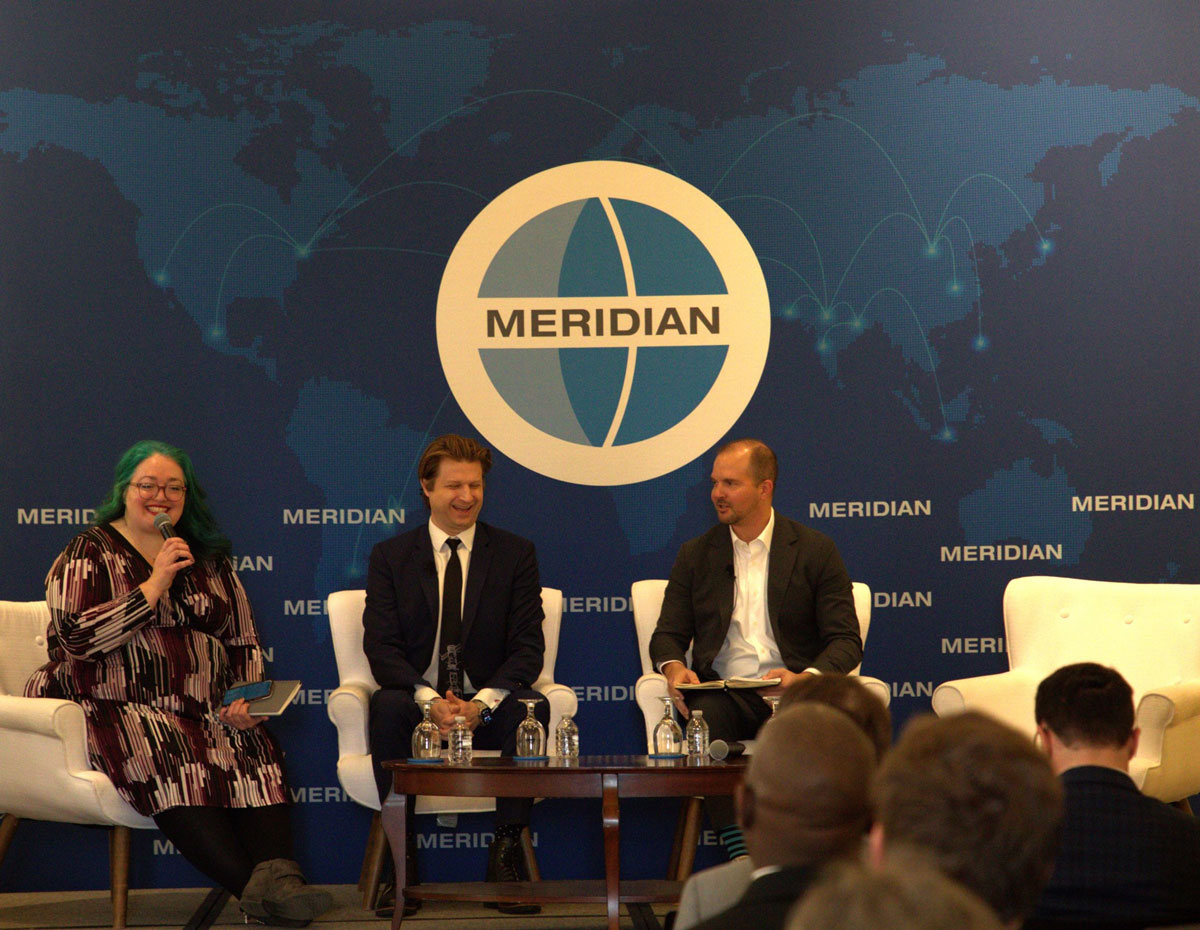
SWF Co-Hosts\ "Celestial Navigation: Space Essentials for New Actors"


Speakers
Co-Sponsors
In January 2025, SWF co-hosted Celestial Navigation: Space Essentials for New Actors with the Meridian International Center at Meridian House in Washington, DC. The program brought together about 65 participants from government, diplomacy, and industry for a practical discussion on how emerging space actors can build sustainable national space programs.
The event grew out of SWF’s engagement with Meridian’s Space Diplomacy Initiative and helped introduce the second edition of SWF’s Handbook for New Actors in Space to a diplomatic audience that increasingly works on space issues without always having technical space expertise. SWF helped shape the agenda, supported the breakfast event, and provided speakers and staff support.
Krystal Azelton opened the program with remarks on the Handbook, followed by a diplomatic panel featuring representatives from New Zealand, Argentina, and Brazil, and a private sector panel moderated by Victoria Samson. Speakers included Frank Justice of Meridian, Matthew Linton of True Anomaly, Marta Mager of the New Zealand Space Agency, Jason Mallare of Umbra Space, Carlos Múscari of the Embassy of Argentina, and Paulo Cezar Rotella Braga of the Embassy of Brazil.
The discussion focused on the building blocks new space actors need before moving into more complex activities: workforce development, public support, clear regulation, public-private cooperation, and international engagement. Panelists also discussed how satellite technology can support national priorities in sectors such as agriculture, energy, and disaster response.
Across the program, speakers returned to a central point: new space actors do not have to build alone. They can learn from established agencies, adapt best practices, and use resources such as SWF’s Handbook to understand the legal, policy, and sustainability issues that shape responsible space activity. The event also strengthened SWF’s relationship with Meridian and paved the way for future collaboration on space diplomacy, capacity building, and outreach to emerging space communities.
From the Meridian International Center's event page, here are the key takeaways from the event:
1. Investing in the Future
The future of space rests in the hands of the next generation: consequently, it is vital to inspire and invest in the next generation of leaders to pursue space and technology-related fields. “If you’re not imbuing a sense of awe and wonder in your young generation about what’s possible for space, then they’re going to go off and do other things.” It is “entirely possible for young people to come up with solutions. They just need the right skills, encouragement and training, and we need to do a better job of that,” Matthew Linton highlighted.
Frank Justice underscored how some nascent spacefaring nations often focus their energy and resources on highly technical and complex areas like launch capabilities when they would be better served by starting with capacity building and workforce development needs. Paulo Braga further detailed the importance of building up educational institutions. For instance, the Brazilian Space Agency implemented a series of joint actions aimed at promoting Science, Technology, Engineering, the Arts and Mathematics (STEAM) training, as well as Astronautics, Space Applications, and Astronomy and Astrophysics in elementary education. Investing in a nation’s own people allows nations to export their capacity and for their entire space sector to flourish.
Equally as important, before jumping to “step five or six” of a space program as Mr. Justice noted, is first showcasing to constituents around the world that advancing sustainable and strategic work in space benefits their lives. This outreach work can help garner support for the expansion of space initiatives, especially in pre-emerging space facing nations. Mr. Braga pointed out that demonstrating the importance of space engagement is particularly important for developing countries, who must justify the money spent on space programs. To do so, Brazil created the National Space Activities Program (PNAE), which coordinates between the government, academia, industries, and civil society to raise awareness about the country’s space activities. The Brazilian Space Agency also holds workshops with different stakeholders to showcase the importance of international agreements, like the Artemis Accords, and how parties can participate in the program’s objectives.
2. Public-Private Partnerships
Collaboration and information sharing between the government and commercial sectors on research, data and in other areas is vital to making technological and scientific advancements. Both parties can identify collective challenges and work together, within their respective capacities, to find solutions. Public-private partnerships play a particularly important role in the satellite industry. Engaging with the commercial sector fosters innovation and expands the reach of satellite technology, which governments can supplement by providing funding and supporting start-ups. At the same time, the public sector must be prepared to fill in gaps left from the private sector. Mr. Braga advised, “Some of the services we need for satellites is not interesting to the private sector sometimes, so we [the government] have to provide those capabilities and services.”
Advancing satellite technology is not only important for space exploration, but for economic development as well. Speaking about the satellite industry, Carlos Múscari, commented, “We have aligned our [satellite] industry to our national needs.” Argentina leverages satellite technology by tailoring it to the needs of key national industries like oil and agriculture, accelerating national development in the process.
3. An Environment for Innovation
Growing the private sector is key to advancing space technology and innovation for nations around the world – as investment in turn spurs innovation. For policymakers, this requires maintaining a delicate balance between preserving national security and promoting innovation, with nations often falling too closely on either end of the extreme. Too much focus on national security priorities may lead to overregulation and overclassification that can stifle the environment necessary for innovation. This may also make it extremely difficult to work with international partners/clients thereby impeding the economic and scientific benefits of international space cooperation. Jason Mallare provided an example of the challenges that can emerge as companies develop new, revolutionary technologies, but are unable to deploy them. UMBRA created SAR (Synthetic Aperture Radar) technology that can image areas without light. However, their technology was too advanced: the law did not permit such high-resolution imaging to be possible. Ultimately, such policies were reversed, allowing UMBRA to continue developing technology that could transform the nation’s ability to respond to natural disasters.
For new companies entering the space industry, Mr. Mallare gave a few key recommendations regarding regulations. “As you’re employing regulations in place, make sure to think about making it as centralized and transparent as possible,” which makes regulations easy to access and understand for employees. Moreover, maintaining transparency in companies’ compliance with national and international regulations is vital—it instills trust in potential investors and stakeholders, fostering development and advancement. Mr. Mallare ended with a final piece of advice: “fail early and fail often.” Innovation cannot happen overnight, so persistence and problem-solving are essential."
4. United for the Universe
For safe, sustainable space development, cooperation across borders will be necessary. International forums, like the Artemis Accords, promote the responsible use of space and transparency from countries about their space programs, which can promote peace on the global stage. For Brazil, the Artemis Accords provided the rationale to spur further investment into space programs. The Accords have functioned as a “motor for development” for key industries like mining and space agriculture.
Marta Mager commented, “It's an advantage when you're a new space agency that you can go out and figure out what others are doing…and learn from their mistakes.”
Furthermore, best practice sharing can give countries just entering the field a head start. Through the Latin American and Caribbean Space Agency, Argentina has been able to coordinate regional cooperation and information sharing amongst other space-faring nations, bolstering all involved country’s capabilities.
5. Space Sustainability Today for a Lasting LEO Tomorrow
As Marta Mager pointed out, space sustainability is arguably the most important factor for new space actors to consider as Lower Earth Orbit (LEO) becomes increasingly saturated with new satellite constellations and other forms of space traffic. New Zealand serves as a terrific model for other countries. In 2017, the newly formed New Zealand Space Agency made sustainability a key part of their regime. In doing so, they adapted policies such as Space Situational Awareness (SSA) into their regulatory regime. New Zealand’s Space Agency is also setting the tone for emerging nations safe, sustainable space exploration by registering satellites they send into orbit and partnering with non-profits to monitor emissions.
The Secure World Foundation’s Handbook is also a helpful tool for new actors looking to understand international environmental regulations for space activities and policy recommendations.
Event Details
Agenda
Event Coverage
Lorem ipsum dolor sit amet, consectetur adipiscing elit. Suspendisse varius enim in eros elementum tristique. Duis cursus, mi quis viverra ornare, eros dolor interdum nulla, ut commodo diam libero vitae erat. Aenean faucibus nibh et justo cursus id rutrum lorem imperdiet. Nunc ut sem vitae risus tristique posuere.