


Secure World Foundation has published a new white paper, “Assessing the Atmospheric Impact of Satellite Re-Entry in the Large Constellation Era,” submitted in response to the National Academies of Sciences, Engineering, and Medicine’s Decadal Survey for Earth Science and Applications from Space 2028–2037.
The paper focuses on an emerging Earth-system research question: how the rapid growth of satellite constellations may affect the atmosphere as more spacecraft re-enter and demise at the end of their operational lives.
Many satellites in low Earth orbit are designed to re-enter the atmosphere after roughly five to seven years. During re-entry, spacecraft ablate in the upper atmosphere, releasing metallic particles and aerosols. As satellite populations grow, these spacecraft-derived materials are becoming a more routine input into Earth’s atmosphere.
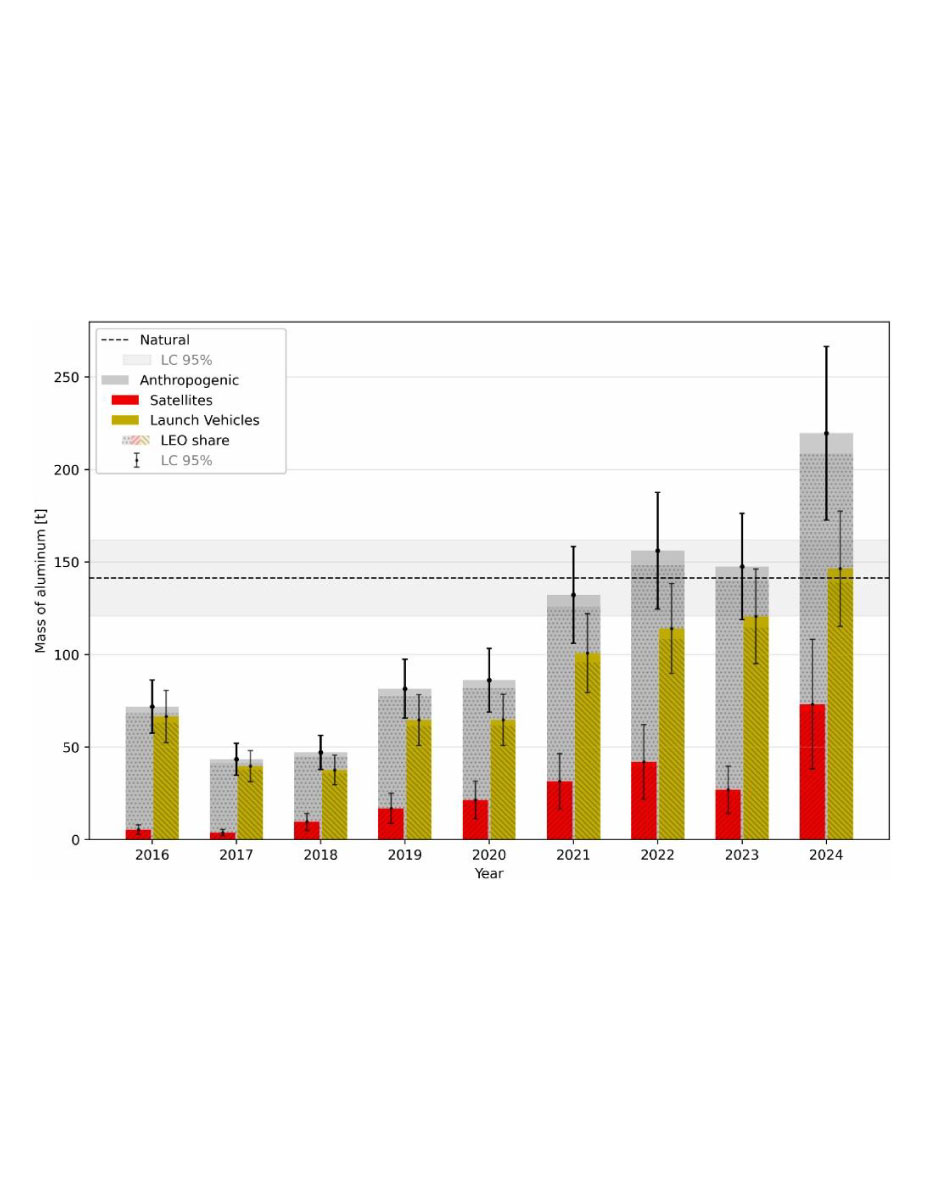
Early research has detected spacecraft-derived metals in stratospheric aerosols and indicates that anthropogenic inputs now exceed natural meteoritic inputs for a growing number of elements. The paper notes, however, that major scientific uncertainties remain. Researchers still need better data on the composition and quantity of materials released during re-entry, how resulting particles move through and persist in the atmosphere, and what effects they may have on atmospheric chemistry, dynamics, and ozone chemistry.
The paper also highlights the role of space weather. Atmospheric density in low Earth orbit changes with solar activity, including solar extreme ultraviolet radiation and geomagnetic storms. These changes can increase drag, accelerate orbital decay, and affect the timing and rate of satellite re-entry. Solar Cycle 25 reached its maximum in late 2024, the first solar maximum of the large-constellation era. The next solar maximum is expected during the 2028–2037 decadal survey period, when a much larger satellite population may be in orbit.
SWF recommends that ESAS 2028 recognize the atmospheric effects of spacecraft re-entry as a measurement priority, support sustained in-situ observation of metals and aerosols in the stratosphere, improve laboratory and flight characterization of spacecraft ablation, and coordinate with the heliophysics community to better account for solar and geomagnetic variability.
The paper was authored by SWF's Alex Shi, Ph.D.; Krystal Azelton; Ian Christensen; Peter Martinez, Ph.D.; and Piyush M. Mehta, Ph.D., of West Virginia University.
The publication builds on SWF’s broader work examining the environmental effects of increasing space activity, including the 2025 Insight, “Clearing the Air: Understanding and Engaging on Possible Atmospheric Impacts of Space Activities.”