
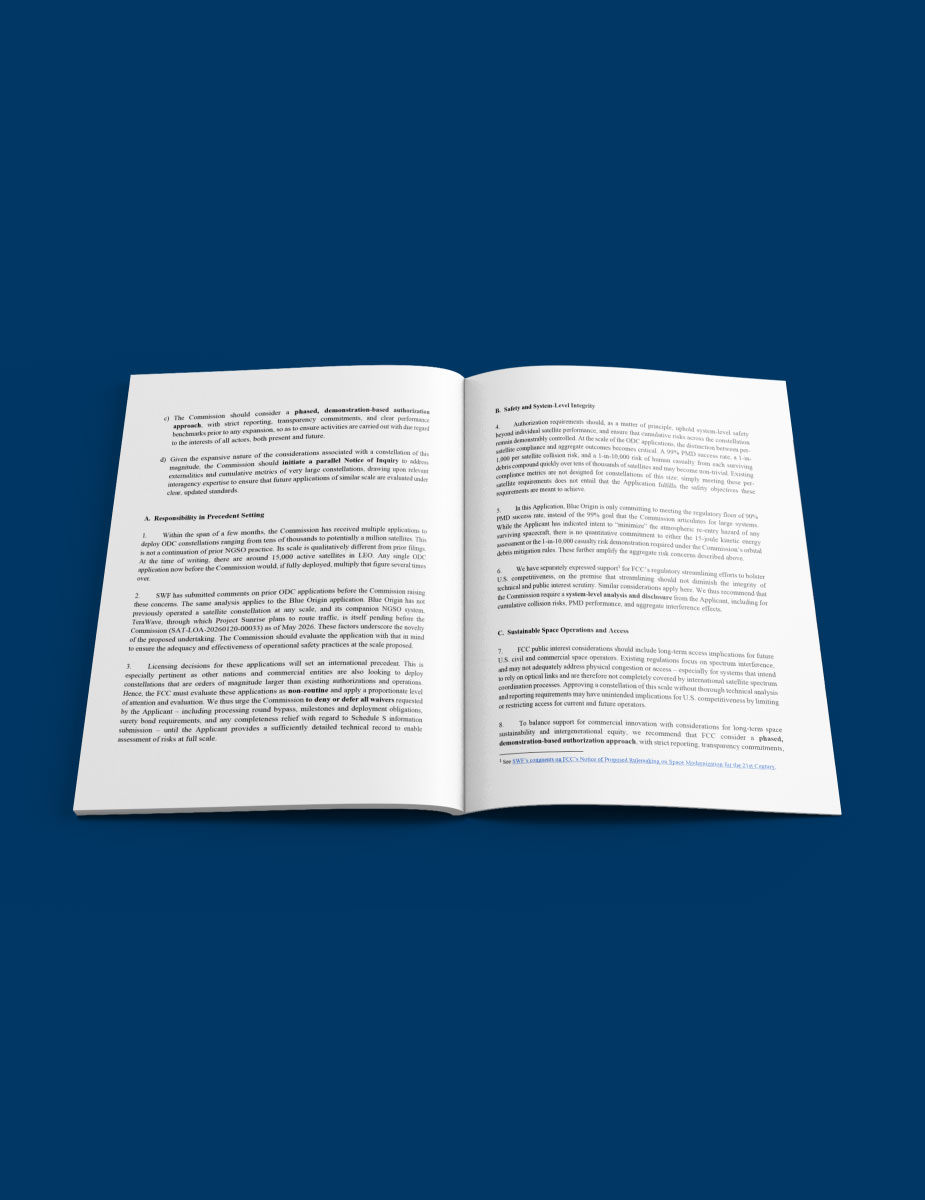

Secure World Foundation has published three FCC filings addressing recent applications for orbital data center constellations by SpaceX, Starcloud, and Blue Origin.
Taken together, the filings make a simple point: these applications should not be treated as routine satellite licensing matters. In each case, SWF argues that the current wave of orbital data center proposals represents a qualitative shift in the scale of proposed satellite constellation operations. These are not incremental expansions of existing non-geostationary orbit licensing practice. They raise novel technical, environmental, and governance questions that extend beyond the FCC’s routine licensing practice and expertise, and they warrant closer regulatory scrutiny and system-level evaluation.
In its comments, SWF recognizes the important role that U.S. commercial innovation has played in advancing space capabilities. The filings are not arguments against innovation. They are arguments for regulatory oversight at a moment when some proposed constellations would add tens of thousands, or even far more, satellites to an orbital environment already under strain. SWF urges the FCC to evaluate these applications as precedent-setting, non-routine requests and to defer or deny waivers until applicants provide a sufficiently detailed technical record to assess risks at full scale.
Across all three filings, SWF asks the Commission to require system-level analysis and disclosure, including cumulative collision risks, post-mission disposal performance, and aggregate interference effects. The filings also recommend a phased, demonstration-based authorization approach, with strict reporting, transparency commitments, and clear performance benchmarks before any expansion. And because these applications raise broader questions that go beyond any single filing, SWF recommends that the FCC initiate a parallel Notice of Inquiry on the externalities and cumulative metrics of very large constellations, drawing on relevant interagency expertise.
The SpaceX filing notes that SpaceX has demonstrated leadership in operational safety, transparency, and responsible debris mitigation practices, while still arguing that its orbital data center proposal is unprecedented in scale and should receive commensurate scrutiny. The Starcloud and Blue Origin filings make a similar case, emphasizing that the current wave of ODC applications could set international precedent and should be evaluated with long-term sustainability, access, and governance in mind.
You can read the filings here: