


The Counterspace Surge: A Year of Acceleration



The past year has been an incredibly busy one for counterspace trackers: the 9th iteration of SWF’s annual report, Global Counterspace Capabilities: An Open Source Assessment, added 90 pages of content from last year’s version. Nations around the globe are increasingly interested in researching, developing, and (at times) fielding counterspace capabilities intended to disrupt, deny, degrade, or destroy access to or use of space. Our hope is that this report will help elucidate a complicated subject matter so that there can be a more open and public debate on these issues, as space is not the sole domain of militaries or intelligence services. We believe that a holistic, comparative view of what is happening in counterspace can help policymakers to make more informed decisions about programs, priorities, and budget allocations.
Our report compiles and assesses open-source information on counterspace capabilities being developed by 13 countries across five categories: co-orbital, direct-ascent, electronic warfare, directed energy, and cyber. Additionally, it examines space situational awareness capabilities, along with policies, organizations, and budgets related to counterspace capabilities. Covered in this report: the United States, Russia, China, India, Australia, France, Germany (new as of 2026), Iran, Israel, Japan, North Korea, South Korea, and the United Kingdom. The report assesses current and near-term future capabilities for each, along with their potential military utility. Co-edited by Victoria Samson, SWF Chief Director, Space Security and Stability, and Kathleen Brett, SWF Program Analyst, Space Security and Stability, with significant contributions from Emily Kunasek, SWF Program Associate, this report contains updates on counterspace activities through February 2026.
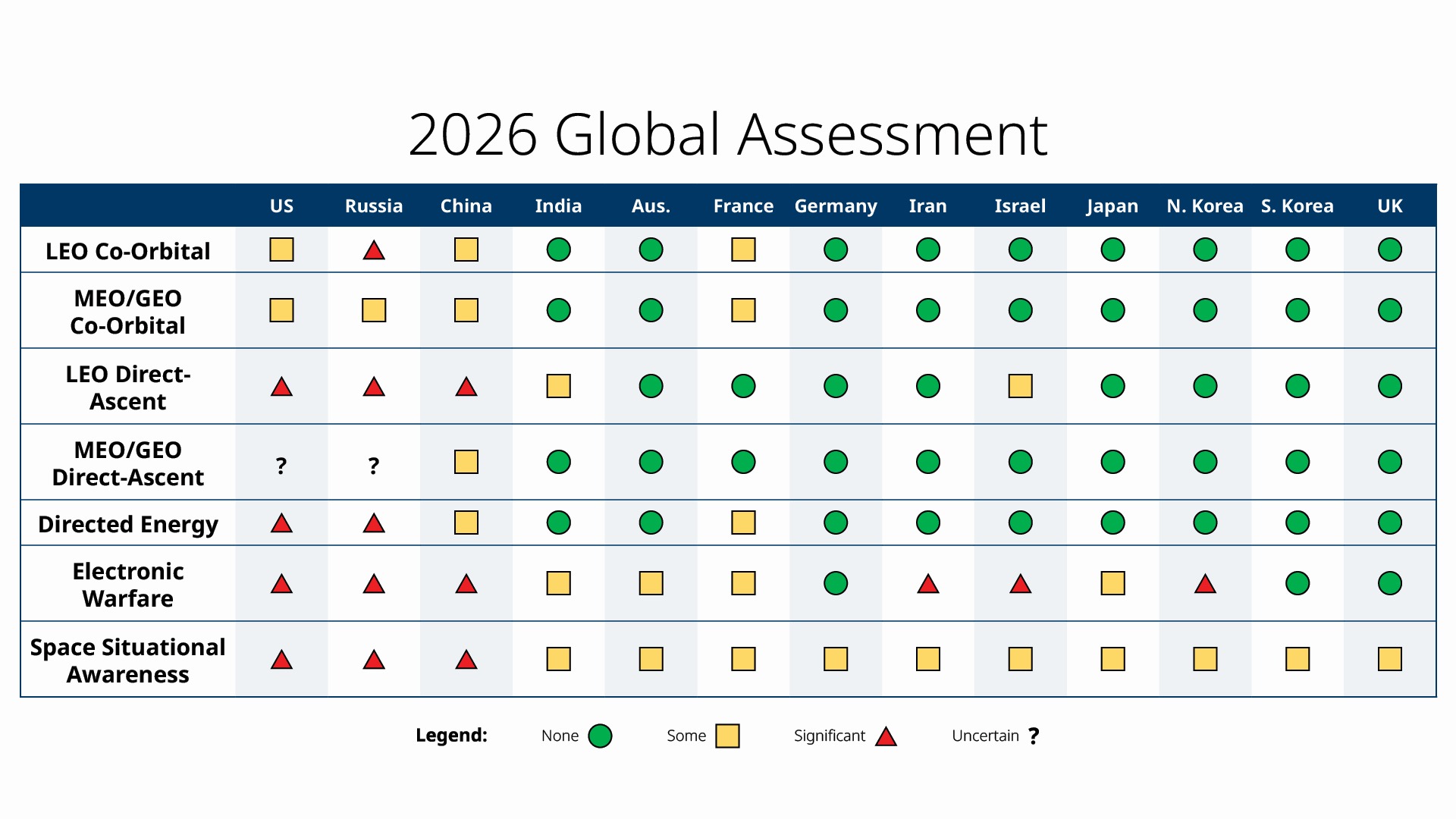
Throughout the existence of this report, nations have been conducting extensive research and development into destructive and non-destructive counterspace capabilities. However, only non-destructive counterspace capabilities are being used in active conflicts. Some of the 2026 highlights:
- We are seeing a growing interest in co-orbital “bodyguard” satellites and spaceplanes. Four countries have now expressed interest/started programs to develop these types of satellites that would provide them with a co-orbital counterspace capability: France, Germany, India, and Japan. The United States’ and China’s spaceplanes are both on-orbit right now; India is continuing to develop its own; and Germany has the policies in place to start researching and developing one.
- The United States released a considerable number of policies and doctrinal strategy documents over the past year, with a heavy emphasis on dynamic space operations. There are still a lot of knowns and unknowns regarding the United States’ Golden Dome missile defense initiative. While this is still a priority for the US government, there has been a lack of public updates and transparency on the system. Despite this, contracts have been awarded for some aspects of it, including at least one for space-based interceptor prototypes.
- Starlink continues to play a major role in conflict areas. Iran managed to spoof Starlink terminals to (briefly) kick its population off the internet during January 2026 protests. Meanwhile, Russian troops were using Starlink in the war in Ukraine, spurring the Ukrainian government to work with SpaceX to put guardrails in place to get them off of it.
- Complicated RPOs continue to be undertaken. China’s satellites SJ-21 and SJ-25 conducted dockings and undockings during the second half of 2025 and are thought to have undertaken an on-orbit refueling; if so, this would be a first (China has not stated anything publicly about these actions). The United States’ GSSAPs conducted close approaches of China’s TJS-15, TJS-16, and TJS-17 satellites. Russian satellites released objects and conducted RPOs with them, as well as with other Russian satellites. And new actors have started conducting RPOs: both the United Kingdom and France conducted coordinated RPOs with the United States in 2025.
- Many new or updated national policies were released. These include the Stratégie Nationale Spatiale 2025-2040 (France), the Space Safety and Security Strategy (Germany), the Space Domain Defense Guidelines (Japan), Joint Military Space Doctrine (India), and Strategic Defence Review (United Kingdom). Additionally, the United States released its capstone operations document, Space Force Doctrine Document (SFDD)-1, as well as Space Warfighting: A Framework for Planners, the Space Force’s International Partnership Strategy, and Vector 2025.
- Cyberattacks have been an active part of the Russia-Ukraine war. From February 2022 through March 2025, 161 cyber operations were aimed at the space sector as part of that war; these cyber operations came from Russian and Ukrainian sources and targeted 72 entities representing both sides of the combatants. Hacktivists appear to be fairly new to the space sector and have at times misidentified targets or had unclear connections to their stated targets. For example, when the Finnish company ICEYE signed a contract in August 2022 to provide SAR imagery for Ukraine, the Cyber Army of Russia called for a distributed denial of service (DDOS) attack on ICEYE and released a URL and IP address in support of that goal. However, the URL released was that of ESA’s Earth Online portal; it was unclear whether the hacktivist group meant to target ESA or if they had misunderstood the relationship between ESA and ICEYE.
- The addition of Germany’s counterspace capabilities to the 2026 report is a significant highlight as well. While Germany historically has had a civil focus to its space program, its military, the Bundeswehr, is currently working to expand its presence in orbit. The combination of significant planned investment in space and defense systems over the next five years, their new space strategy, and increased engagement in space surveillance points to an increase in German abilities to develop the necessary capabilities to potentially carry out attacks against space systems, should it choose to do so.
The 2026 report updated the amount of space debris created by the United States, Russia, China, and India from their anti-satellite testing in space. Of the 6904 pieces of debris catalogued from tests, 2773 are still on orbit, underlining the long-lived nature of much of this debris and an argument against holding these types of tests.
The purpose of this report is to provide a public assessment of counterspace capabilities being developed by countries, based on unclassified information. We hope this research increases public knowledge of these issues, the willingness of policymakers to discuss them openly, and the involvement of other stakeholders in the debate. Effective policy requires reliable information; it is our hope that this report will continue to serve as an objective and dependable source of information for all.

