


Responsible Investment in the Space Sector: A Guide to Stewardship for Sustainable Value Creation


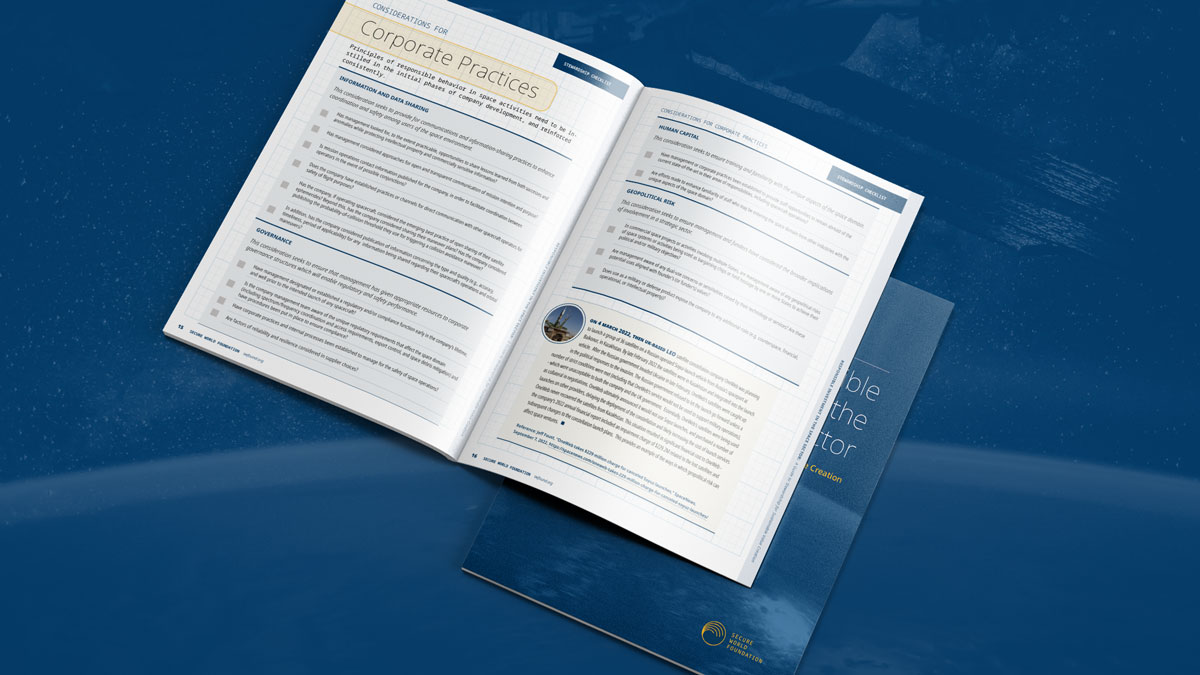
The Responsible Investment in the Space Sector: A Guide to Stewardship for Sustainable Value Creation, explains why investment in the space sector calls for more than standard financial due diligence. It treats space as a strategic, shared, harsh, and uncertain domain where investment decisions can shape operational behavior in orbit, affect long-term stability, and influence future value creation across the space economy.
The guide begins by framing space as an emerging economic domain with its own operating rules. It explains that space technology and satellite services already support modern life, while private capital is helping drive growth in launch, satellite services, in-orbit servicing, manufacturing, human spaceflight, and other new markets. At the same time, the report makes clear that the space economy carries domain-specific risks that do not appear in the same way on Earth. These include natural hazards, orbital debris, orbital congestion, regulatory uncertainty, and geopolitical risk. It argues that short-term investment decisions can create long-term consequences for the space environment and for the companies that depend on it.
The publication then turns to opportunity and risk in the growing space economy. It notes that investors are finding opportunities across services, infrastructure, and downstream sectors that rely on space-enabled data and applications. But it also stresses that many parts of the sector remain volatile, with government demand still anchoring much of the market, some commercial segments struggling to scale, and business models facing delays, consolidation, and pressure from broader macroeconomic trends. The report ties those market realities to operational risk in orbit, showing how debris, congestion, harmful interference, and fragmented regulation can quickly affect performance, cost, and return.
At the center of the guide is a stewardship framework for responsible investment in space. It argues that stewardship is not only about screening risk, but about how investors use influence to protect long-term value, including the shared orbital resources their portfolios depend on. The report links responsible investment to space sustainability, drawing on the United Nations understanding of the long-term sustainability of outer space activities and making the case that one actor’s decisions can affect everyone else’s ability to operate safely. It argues that responsible behavior, predictable operations, and stronger norms support both mission assurance now and market growth over time.
A major strength of the publication is its detailed stewardship checklist for investing responsibly in the space domain. The checklist is designed to help investors assess companies before investment and during active ownership. It covers mission design and operations, launch choices, operational resilience, environmental impact, trackability, collision avoidance, cybersecurity, and post-mission disposal. It also covers corporate practices such as information and data sharing, governance, human capital, and geopolitical risk. Throughout, the guide stays practical. It asks whether companies have built in design-for-demise practices, planned for conjunction assessment, established collision avoidance strategies, published operational contact information, considered open ephemeris sharing, and prepared for the full life cycle of space assets.
The publication closes with direct guidance for investors. It argues that responsible investment in space should include stronger technical, market, and operational due diligence, full life-cycle planning, attention to dual-use risks, and support for best practices that improve safety and sustainability in orbit. It also points to the role investors can play in backing enabling services such as space situational awareness, debris remediation, satellite servicing, and post-mission disposal. The core point is simple: profitability and sustainability in the space sector are linked. Investors can pursue growth, but long-term returns depend on a space environment that remains safe, stable, and usable.

