


Verifying the Prohibition on the Placement of Nuclear Weapons in Outer Space: Legal, Technical, and Policy Pathways

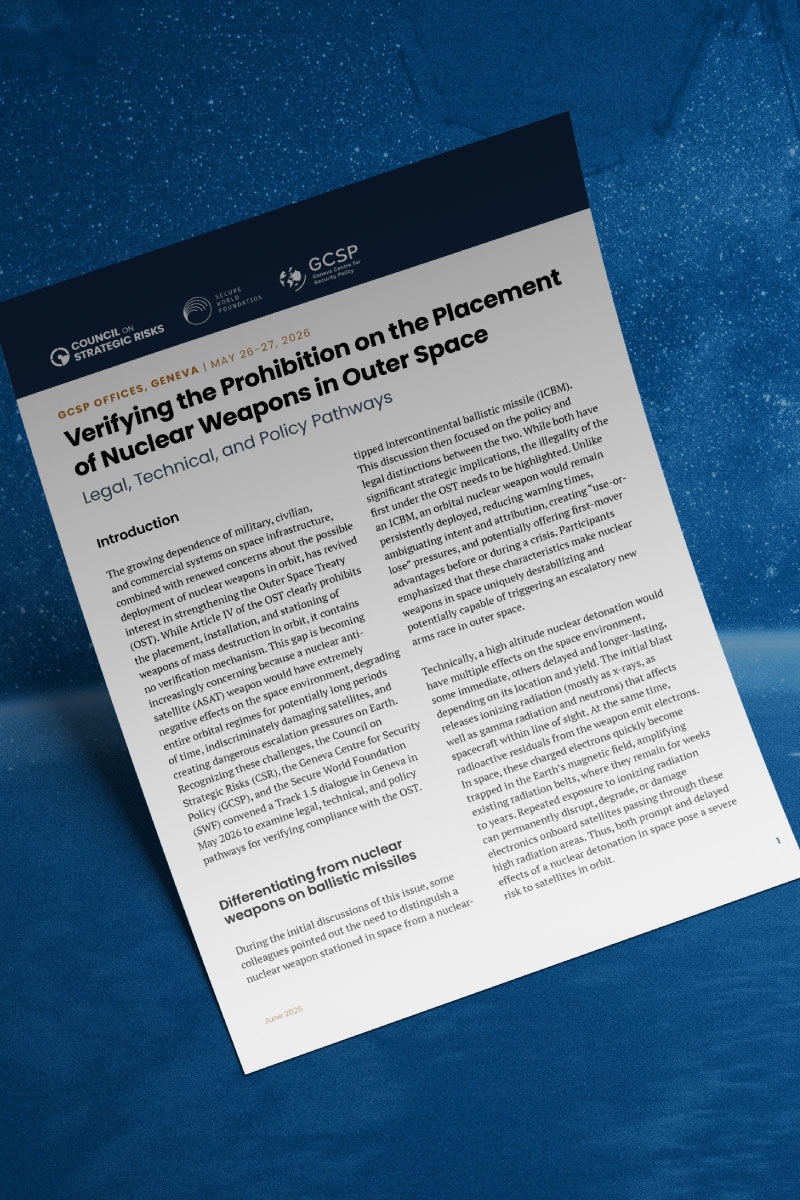
This report draws on a Track 1.5 dialogue convened in Geneva in May 2026 by the Council on Strategic Risks, the Geneva Centre for Security Policy, and Secure World Foundation to examine legal, technical, and policy pathways for verifying compliance with the Outer Space Treaty’s prohibition on the placement of nuclear weapons in outer space. It addresses a central problem directly: while Article IV of the OST clearly prohibits the placement, installation, and stationing of weapons of mass destruction in orbit, it contains no verification mechanism.
The report explains why renewed concerns about the possible deployment of nuclear weapons in orbit have revived interest in strengthening the treaty. Unlike a nuclear-tipped intercontinental ballistic missile, an orbital nuclear weapon would remain persistently deployed, reducing warning times, ambiguating intent and attribution, creating use-or-lose pressures, and potentially offering first-mover advantages before or during a crisis. It also details the likely effects of a nuclear detonation in space, noting that a high-altitude nuclear explosion could indiscriminately damage satellites, amplify existing radiation belts, and degrade entire orbital regimes for potentially long periods of time.
From there, the report turns to the core challenge of verification. It describes the OST as an arms control treaty without a verification regime and examines several practical ways to strengthen compliance without reopening the treaty itself. These include national technical means, possible international verification arrangements, and hybrid approaches that combine national capabilities, commercial data, and international coordination through organizations such as the United Nations Office for Outer Space Affairs or a future international SSA information coordination mechanism. It also reviews a range of technical verification options, including launch-site inspections, challenge inspections, proximity operations, neutron detection, gamma spectroscopy, radiographic techniques, and pattern-of-life analysis.
The report makes clear that no single technical method is likely to be enough. Instead, it argues for a multimodal approach that combines space situational awareness data, radiation signatures, inspections, and commercial sensor networks to provide the highest level of confidence. It also stresses that the value of verification may not lie solely in enforcement. The ability to detect, localize, characterize, and attribute a prohibited weapon could discourage states from attempting deployment in the first place. In that sense, verification supports deterrence as much as compliance.
At the same time, the report argues that verification and attribution alone will not eliminate the drivers that could encourage deployment. It therefore examines the incentives a state might have to pursue a nuclear anti-satellite capability, including concerns about very large satellite constellations, missile defense, deterrence, and a warfighting advantage. It also points to ways to reduce those incentives, including radiation hardening, distributed satellite architectures, rapid reconstitution, more resilient commercial systems, and other measures that lower the military utility of a space-based nuclear weapon.
The report concludes that preserving and strengthening the Outer Space Treaty’s prohibition on nuclear weapons in space is both necessary and achievable, but likely not through treaty renegotiation. A more practical path lies in a layered system of deterrence through education about the threat, SSA, advances in technical options to verify whether satellites are carrying nuclear warheads, commercial participation, and evolving state practice that gradually strengthens compliance and transparency over time.
Contributors
- Mallory Stewart, Council on Strategic Risks
- Almudena Azcárate Ortega, Secure World Foundation
- Simon Cleobury, Geneva Centre for Security Policy
- Jenifer Mackby, Geneva Centre for Security Policy
- Isobel Porteous, Council on Strategic Risks
- Jess Rogers, Council on Strategic Risks
- Victoria Samson, Secure World Foundation

No results. Click here to access other publications.