
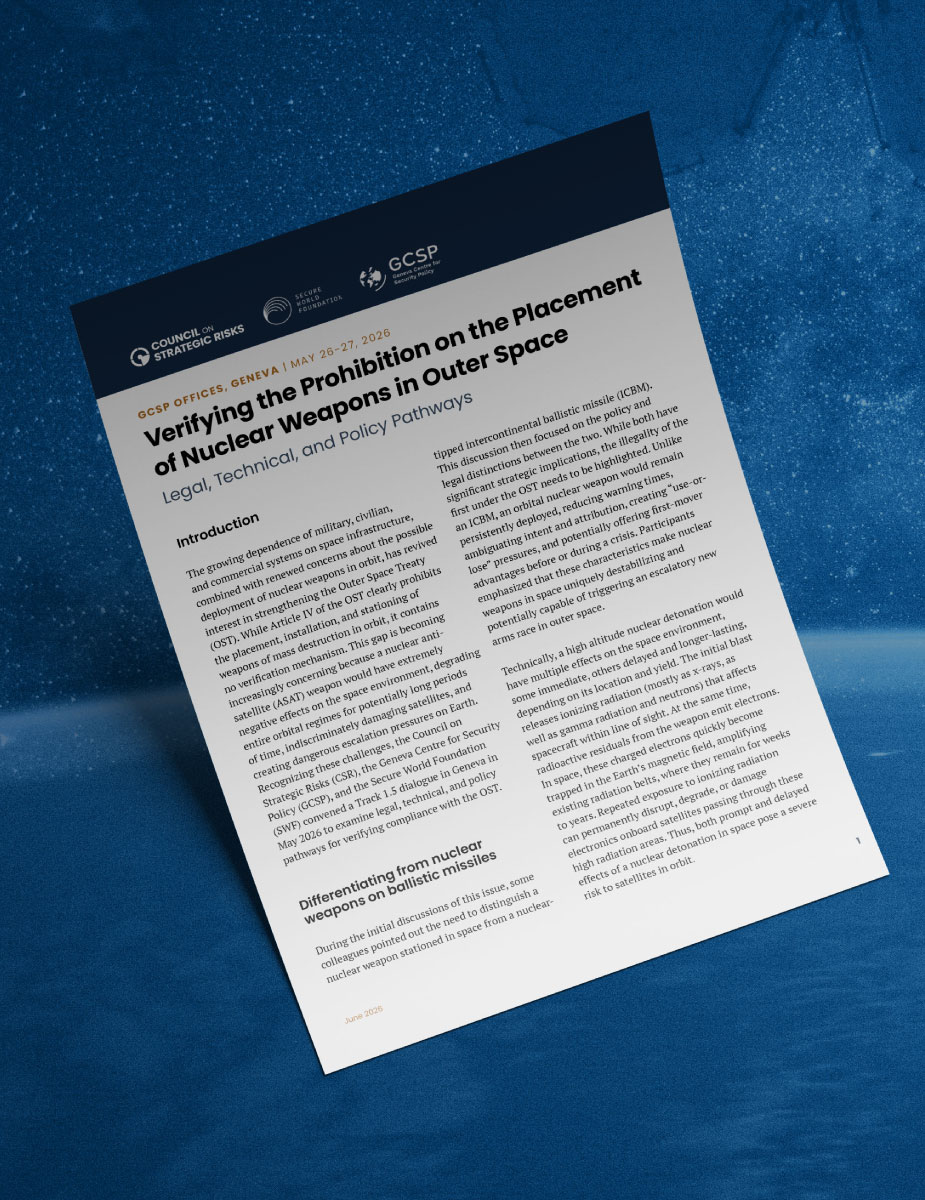

Secure World Foundation, along with the Council on Strategic Risks and the Geneva Centre for Security Policy, has published a new report, Verifying the Prohibition on the Placement of Nuclear Weapons in Outer Space: Legal, Technical, and Policy Pathways.
The report is based on a Track 1.5 dialogue held in Geneva on May 26 and 27, 2026, which brought together legal, technical, and policy experts to examine a basic but difficult question: how can states verify compliance with Article IV of the Outer Space Treaty, which prohibits the placement of nuclear weapons in orbit, without reopening the treaty itself?
Drawing on that discussion, the report looks at several paths forward. It covers legal questions around Article IV, the challenge of distinguishing nuclear weapons from legitimate nuclear power systems in orbit, and a range of verification options, from national technical means and commercial space situational awareness data to inspections, radiation detection, and other technical methods. It also argues that verification matters not only for enforcement, but for deterrence, transparency, and long-term confidence in the treaty regime.
The report makes a practical case for strengthening compliance through a layered approach that combines technical tools, information sharing, confidence-building measures, and clearer expectations for state behavior. It also looks at the incentives that could drive a state to pursue a space-based nuclear weapon and the steps that could reduce those incentives.
Read the full report here:
Verifying the Prohibition on the Placement of Nuclear Weapons in Outer Space: Legal, Technical, and Policy Pathways