


Space Sustainability Infographic


Space sustainability matters because life on Earth already depends on space systems. Satellites support navigation, communications, weather forecasting, Earth observation, global positioning, and early warning services. Most people do not think about those systems every day, but they rely on a space environment that remains safe, secure, and usable over time.
If outer space is not safe, secure, and peaceful, access to it can be denied to everyone. That would affect far more than space programs. Financial transactions, internet access, phone service, data transfer, television, scientific research, economic activity, and national security all depend on space-based systems. Human spaceflight in Earth orbit could also become far more difficult, or even come to an end.
Emerging space countries would face the steepest barriers, making it harder for them to use outer space effectively or build long-term capacity. That is why space sustainability is not an abstract issue. It is about keeping the benefits of space available to everyone.
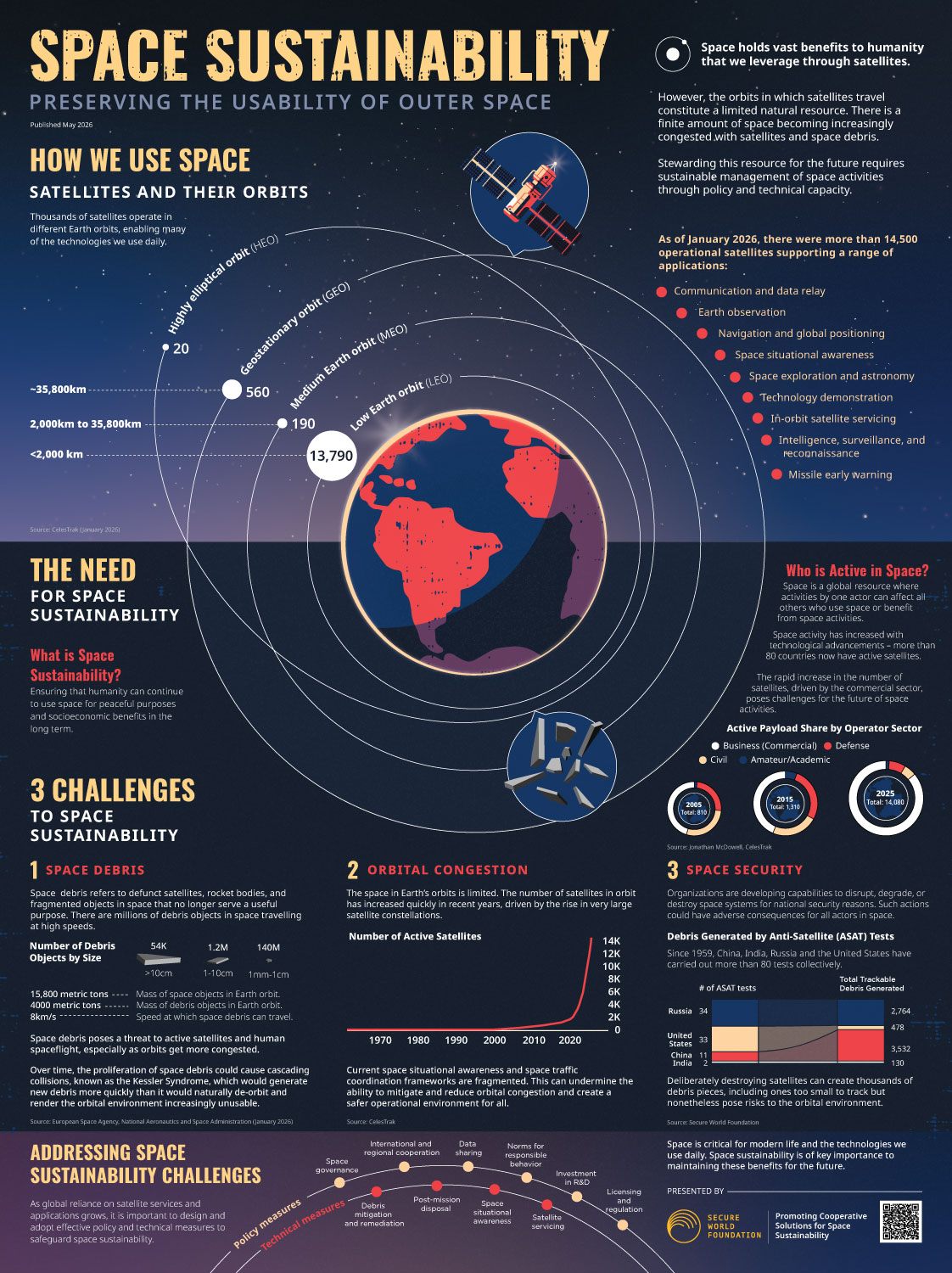
This Space Sustainability Infographic Poster helps make that case in a clear, visual way. It shows how satellites operate across low Earth orbit, medium Earth orbit, geostationary orbit, and highly elliptical orbit, and explains why those orbits should be treated as a limited natural resource. The poster also shows how much space activity has changed. As of January 2026, more than 14,500 operational satellites were supporting a wide range of applications, while more than 80 countries had active satellites in orbit.
This poster highlights three central challenges to space sustainability:
- Space debris: Millions of debris objects remain in orbit, including fragments too small to track but still large enough to damage satellites. The infographic notes that debris can travel at speeds up to 8 km/s, putting both active satellites and human spaceflight at risk. It also explains the danger of cascading collisions, often called the Kessler Syndrome, in which debris creates more debris, making the orbital environment harder to use over time.
- Orbital congestion: Earth’s orbits are limited, and the number of satellites has risen sharply in recent years, driven in part by very large constellations. The infographic shows that current space situational awareness and space traffic coordination frameworks remain fragmented, which makes it harder to manage congestion and maintain a safer operating environment for all space users.
- Space security: Some organizations are developing capabilities to disrupt, degrade, or destroy space systems for national security reasons. The infographic points to anti-satellite testing as one example, noting that tests by China, India, Russia, and the United States have generated trackable debris and broader risks for all actors using space.
The poster also maps out the policy and technical measures needed to address those challenges. These include debris mitigation and remediation, post-mission disposal, space situational awareness, satellite servicing, data sharing, licensing and regulation, research and development, and international and regional cooperation. That makes the infographic useful as both a public-facing explainer and a quick reference for people working on space governance, orbital debris, and the long-term sustainability of space activities.
Published in May 2026, this version updates earlier SWF work with current figures and framing. It is designed to help readers quickly understand how space supports life on Earth, what threatens that access, and what can be done to protect it. Efforts to update this publication were led by Alex Shi and Emily Kunasek.

